by Josh Soffler
On the 21st and 22nd of this past June, I traveled to Uniontown, Pennsylvania, on behalf of the Association for Union Democracy. Just an hour South of Pittsburgh, the Pennsylvania Labor History Society was hosting a conference titled “Honoring the Legacy of Jock Yablonski and the Miners for Democracy.” Attendance at this conference for AUD was fitting as AUD has a long history of supporting the Miners for Democracy Movement, going back to our first few issues of Union Democracy Review, where Herman Benson covered the murders of Jock Yablonski and his family and the subsequent involvement of the Department of Labor in the UMWA officer elections. Along with this, the latest addition to AUD’s Board of Directors is Professor Paul F. Clark, a professor of labor and employment relations and criminology at Pennsylvania State University who has done extensive research on labor unions and union democracy. He is also the author of The Miners’ Fight for Democracy: Arnold Miller and the Reform of the United Mine Workers. Paul helped host the conference and is now the newly elected president of the Pennsylvania Labor History Society.
The conference was hosted at Pennsylvania State College Fayette, The Eberly Campus in Uniontown. The Eberly Campus is home to the Coal & Coke Heritage Center, a museum focusing on life surrounding the bituminous coal and coke industries in southwestern Pennsylvania. Not only does the museum focus on the people living in the region and their ways of life, but it also explores the history of industry and the United Mine Workers of America (UMWA). Unfortunately, just as the museum was about to reopen after years of renovation, Penn State’s Board of Trustees voted to close seven branch campuses, including the Fayette campus. The fate of the museum is currently unknown, but they hope to remain in Fayette County.
After a short presentation from the university archivist about the Coal & Coke Heritage Center and the campus, we heard an online presentation from Miners for Democracy (MFD) reformer and lawyer, Joseph “Chip” Yablonski, son of Jock Yablonski. Chip discussed the election of Arnold Miller to the presidency of the UMWA and the subsequent changes in staff when the Miller administration took power.
The next presentation was called “The Importance of the Miners for Democracy Movement,” presented by former UMWA District 2 Leaders Nick Molnar and Mike Healey. They recounted the reform movement, the early conventions, and the changes to the union’s structure and its ability to win a strong contract for miners. They brought up the idea that unions lie on a spectrum between town meetings and armies, and what balance they strike determines how effective and how democratic they are. The 1973 convention was the battleground for finding that balance as reformers rewrote large parts of the UMWA constitution.
That evening, an award ceremony was held where Cecil Roberts, current president of the UMWA, gave the keynote speech. He retold the story of the union before Jock Yablonski and how he stood up to Tony Boyle and lost his life for the cause of union democracy. Roberts said, “We owe him so much. Every time I run for office, every time I make a speech, I think of Jock. Miller and MFD won because of the courage of Jock Yablonski.” After the roaring speech, Cecil Roberts was awarded the Mother Jones Award for leadership. Paul Clark was awarded the John Brennan Award for education. William Sylvis, who is the financial secretary for UMWA Local Union 762, was awarded the Rita Jo Yanko Award for organizing. Bill Yund, a member of Insulators Local 2 and an artist, was awarded the Russell Gibbons award for journalism. And Clemmy Allen, the director of the UMWA Career Centers, Inc., was awarded the Alice Hoffman Community Service Award. The evening ended with a showing of the film Harlan County, U.S.A., which follows the story of a brutal strike at the Brookside Mine in Harlan County, Kentucky, as well as the formation of Miners for Democracy and the campaign and election of Arnold Miller to the UMWA presidency.
The next morning, Paul Clark gave a presentation on “How the Miners for Democracy Movement Transformed the UMWA.” He explored the ideas behind the early reforms of the Miller administration, such as calling for the direct election of district officers, having a bigger role for members in bargaining contracts, and having delegate elections to open up the convention to be more transparent and democratic. The early conventions were quite chaotic as many of the delegates were new and hadn’t much experience in the inner workings of parliamentary rules. Following this, there was a great conversation about the Miller administration’s shortcomings, but how the framework they set up through constitutional reforms preserved the union’s internal democracy for years to come.
Following a beautiful performance from Tom Breiding, the UMWA Artist in Residence, of several labor and miner songs, we set off to the town of Dunbar. Here, the Dunbar Historical Society gave us a tour of the newly constructed Coke Oven that was built from original unused bricks and materials found at the Shamrock and Shoaf Coke Works. The conference concluded after the tour and lunch. AUD is extremely grateful to have been a part of the conference and to have been able to table and talk to unionists about the cause of union democracy.
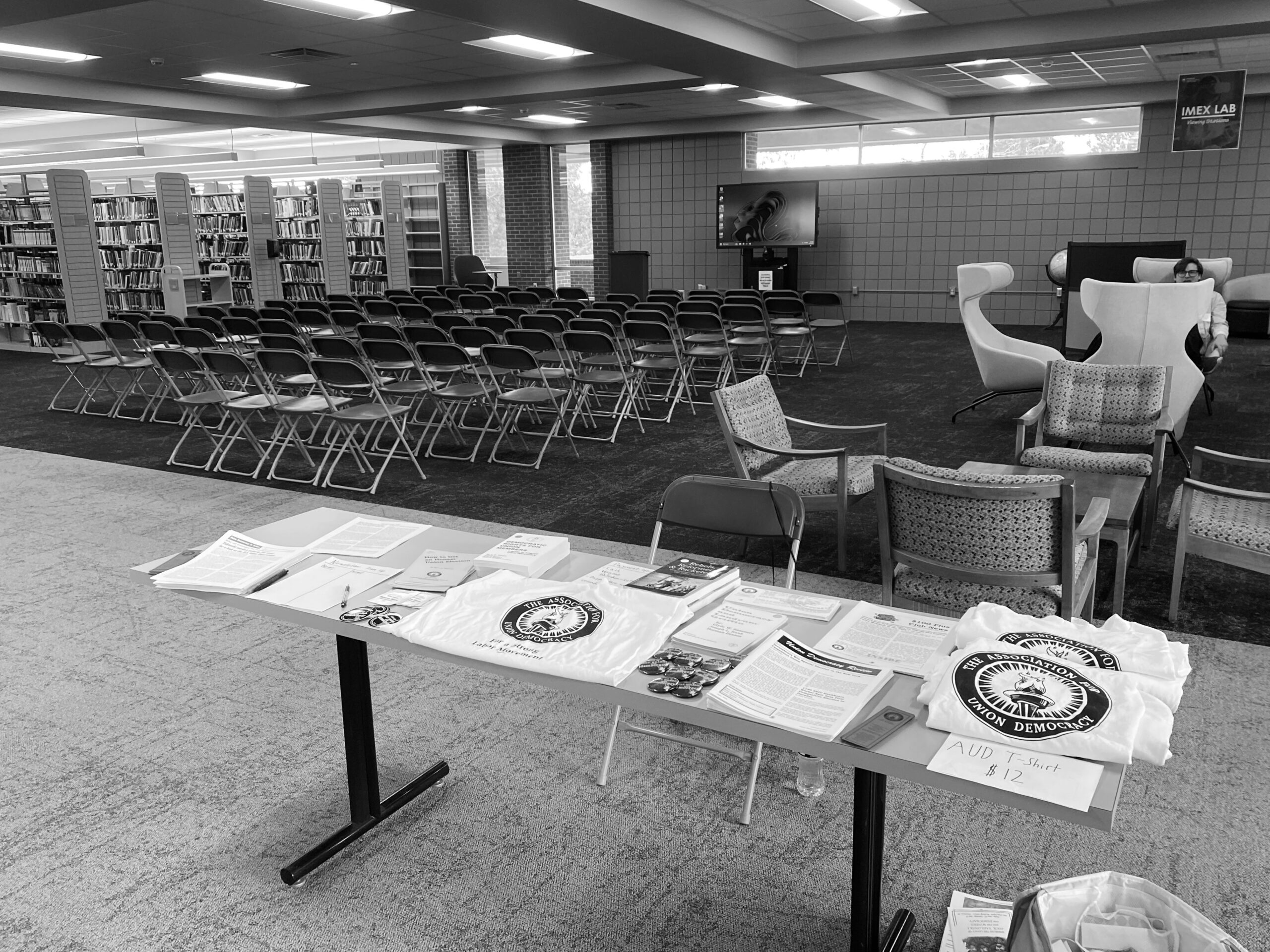
AUD’s Table at the conference, “Honoring the Legacy of Jock Yablonski and the Miners for Democracy.”