As reported in UDR 222, candidates for union office who file election protests with the Office of Labor Management Standards (OLMS) of the US Dept. of Labor (DoL), but lose this protest, often wait nearly a year to receive a Statement of Reasons (SoR) from the DoL. This Statement is critical because it is the only communication from DoL that explains why a complainant’s protest was not acted upon. There is an earlier brief “closing letter” provided to the complainant that only indicates the protest is not going to be acted on and the case is closed.
During 2022 AUD received calls from some candidates frustrated with the wait (months and months) for the SoR, and others that said they never got a closing letter. So we reviewed the DoL’s publicly available list of SoR’s issued that year. We initially found that complainants, as of November 2022, had an average wait of 347 days to get the SoR. A subsequent review of 2022, when all Statements for that year were available, found the average wait was 326 days (see Table 1 on page 7).
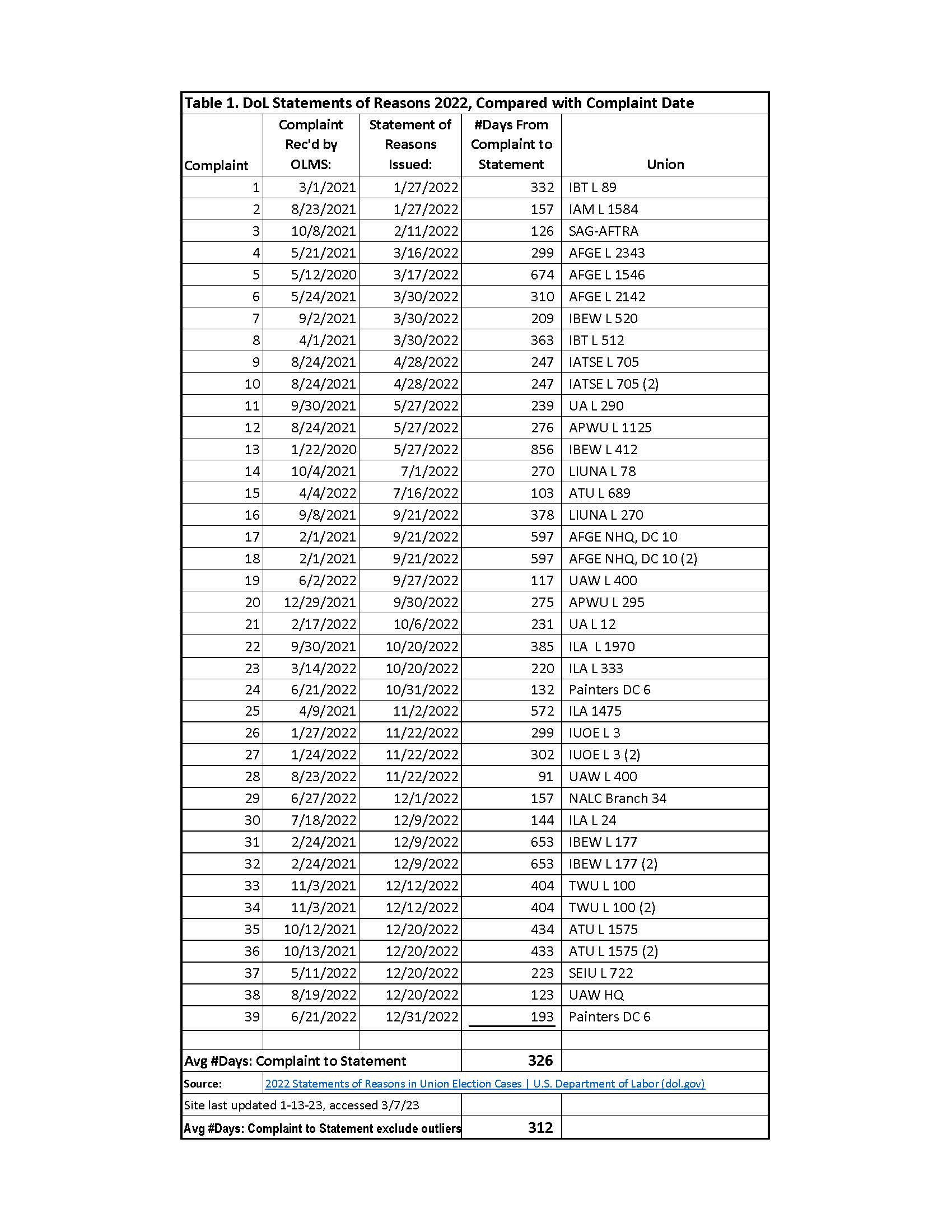
AUD penned a letter to the OLMS in April 2023 making three points. First, we asked for an explanation for the (in our view) inordinate length of time (see editor’s note above) and urged quicker issuance. The second point was that OLMS should, when it conducted a supervised rerun election for one office, for example, President, yet the election for another office, say Vice President, in the same election, is not rerun despite a complaint about it, that the latter, rejected complainant should receive a SoR. The current policy is such a failed complainant is not due a SoR because DoL is rerunning PART of the election. Thirdly our letter pointed out instances made known to us where candidates who filed a complaint never received the closing letter.
In May 2023 OLMS’ Chief of Enforcement Tracy Shanker (Tracy Shanker is currently OLMS Acting Director, Southern Region) responded to AUD by letter. The response to the first point asserted that because of the need to ensure each Statement was researched and written so as to be able to withstand any legal challenges, extended lengths of time between complaint date and SoR date resulted. Resource constraints made addressing our second point impossible, and as to the third point regarding the closing letter or lack thereof, OLMS held that it was policy in every field office to issue such closing letters, and could not explain why a candidate would not receive one.
Notwithstanding the OLMS reply, we can report that the 2023 data indicate improvement in the wait time. As Table 2 on page 6 shows, the average wait is down from 326 to 300 days. Moreover, if we exclude five of the 61 SoRs issued in 2023 that had unusually long waits of over 850 days (and exclude one such outlier from 2022) the average wait has been reduced by 70 days, from 312 to 242.
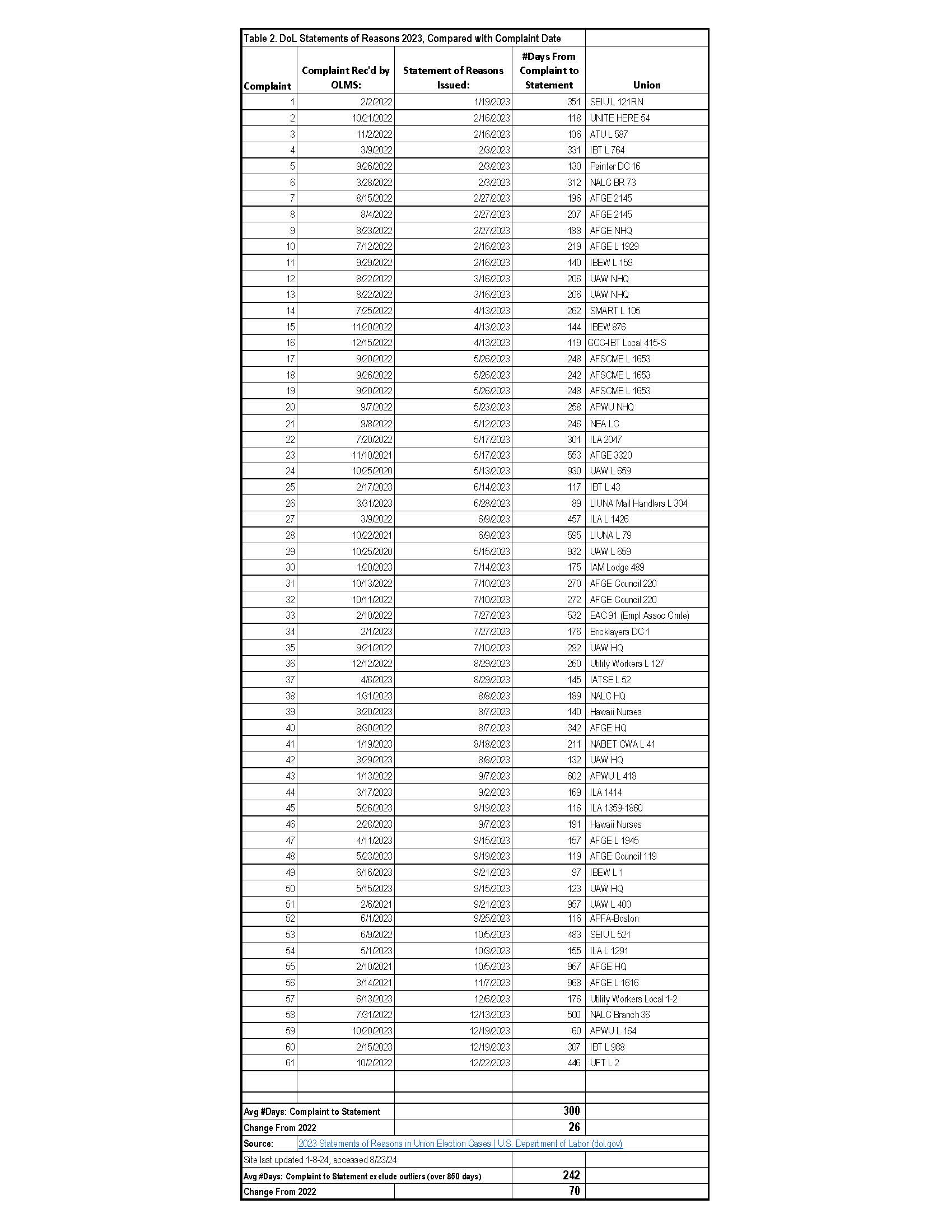
AUD spoke with the OLMS Washington office headquarters regarding the improvement and it is credited to enhanced coordination between OLMS, which conducts the investigation, and the DoL Office of the Solicitor, which authors the SoR. OLMS also indicated they are now considering issuing the closing letters electronically. The current policy is issuance via USPS, but some Statements are returned to OLMS because of a wrong address, prompting this consideration.
AUD will continue to monitor the Statements’ timeliness and hope the 2023 reduction in wait continues this year.
Editors Note: Quoting from the U.S. Supreme Court, Dunlop v. Bachowski, No. 74-466 (Argued April 21, 1975, Decided June 2, 1975, 421 U.S. 560 CERTIORARI TO THE UNITED STATES COURT OF APPEALS FOR THE THIRD CIRCUIT), ‘Congress’ concern was “to settle as quickly as practicable the cloud on the incumbents’ titles to office,” Wirtz v. Bottle Blowers Assn., supra, at 389 U. S. 468 n. 7…’